Rust Application Development Services
Senior engineers who move your slowest or most crash-prone code to Rust and keep the rest of your stack.
Rust development services for custom software: what we cover
Rust application development service for new web and backend products
APIs, workers and data pipelines where latency, memory or cloud cost decide the design. Async on Tokio, HTTP on Axum or Actix.
Python to Rust migration for high-performance services
A slow Python module, such as machine learning feature code, rebuilt in Rust with PyO3 and maturin. Your Python code imports it like any package.
PHP to Rust migration and legacy modernization
PHP keeps the web layer. Heavy jobs move to a Rust service or worker behind your queue or an HTTP API.
Cross-platform Rust cores with Python and Node.js bindings
One library shipped to Python, Node.js and a CLI, so every part of your product runs the same tested logic.
Profiling and performance optimization before a rewrite
We measure latency, CPU and memory first, then name the module worth moving and the number it has to hit.
Rust code review and application audit
A review of your existing codebase: unsafe blocks, error handling, async pitfalls and dependency audits, with a fix plan.

When Rust development pays off: high performance, memory safety, systems programming
The language pays for itself where a hot path costs real money: request latency, cloud bills, crashes or security findings.
For a CRUD admin panel it rarely does, and we tell you that before you spend a sprint on it.
Rust has no garbage collector, so there are no GC pauses, and we benchmark latency under your expected load. For I/O-bound CRUD work, Go, Node.js or Python are usually cheaper to build and staff, and we will say so.
Across the industry Rust runs in embedded systems, blockchain development, game development and shared cores for mobile app development. Our own work sits in backend services, migrations and cross-platform libraries.
Teams that adopt it tend to keep it. In the Stack Overflow Developer Survey 2025, Rust was the most admired language at 72%. In the 2025 State of Rust Survey, 49% of respondents said their organization makes non-trivial use of Rust.Stack Overflow, 2025Rust Blog, 2026
The safety case has numbers too. Google reported in November 2025 that memory safety bugs fell below 20% of Android vulnerabilities for the first time. Its Rust changes spend about 25% less time in code review and are rolled back about 4x less often than C++ changes.Google, 2025
- 72%
- Most admired language, Stack Overflow 2025
- 49%
- Orgs with non-trivial Rust use, 2025
- ~25%
- Less code review time than C++, Google
- ~4x
- Fewer rollbacks than C++, Google
PHP to Rust and Python to Rust migration services by a Rust backend development agency
Most teams do not need a full rewrite.
They need the one service or module that eats CPU, blocks requests or crashes under load moved to Rust, behind the same interface.
For Python, that module becomes a native extension built with PyO3 and maturin: same function names, same test suite. Pydantic took this route for its core, and its maintainers measured version 2 at 4x to 50x faster than version 1.Pydantic, 2022
A separate service works too. In May 2026 PostHog moved a busy endpoint from Django to Rust and went from 60 CPU cores and 270 GB of memory to 2.5 cores and 4.8 GB, with p50 latency down from 40 ms to 4 ms.PostHog, 2026
For PHP, Laravel or Symfony keeps the pages and the admin. Image processing, pricing, search or report jobs move to a Rust worker that reads the same queue, and your PHP team keeps shipping features.Hire PHP Developers
This is part of our AI-assisted modernization work: AI tools draft the port and the parity tests, and a senior engineer reviews every pull request before it merges.Legacy software migration
4x to 50xPydantic v2 speed over v1
- CPU cores
- 602.5
- Memory
- 2704.8GB
- P50 latency
- 404ms
I used to talk CTOs out of Rust. I don't anymore.
The reasons were real: few Rust engineers, each one expensive, and a young ecosystem with fewer ready libraries, so supporting the code cost a lot.
AI coding tools like Anthropic Claude Code and OpenAI Codex close most of that gap. A solid backend or full-stack engineer now gets productive in Rust fast.
So I start with the code that runs most often and burns the most server time. One move buys speed and a smaller cloud bill, without a rare and costly hire.
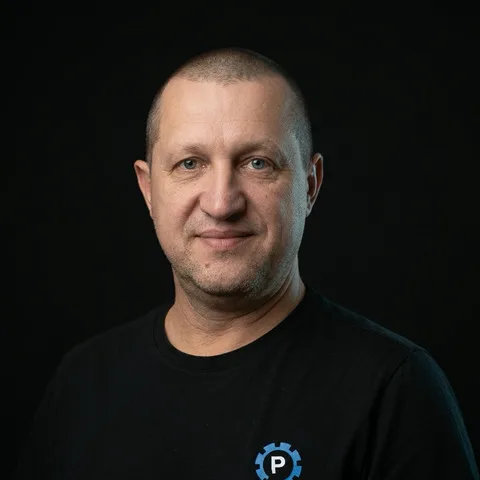
 Oleg KopachovetsFounder and CEO, ProCoders
How our Rust app development service runs a migration to Rust
Profile
We measure p95 latency, CPU and memory in production and agree a target number before any code is written.
Pick the seam
We choose the module with the clearest boundary and the biggest cost, and freeze its interface.
Port with parity tests
The new version runs against recorded inputs from the old code until the outputs match.
Shadow, then switch
Both versions run on live traffic. We switch behind a flag and keep the old path for rollback.
Hand over
You get the code, CI, benchmarks and docs, with 100% IP transfer and a 3-month warranty.
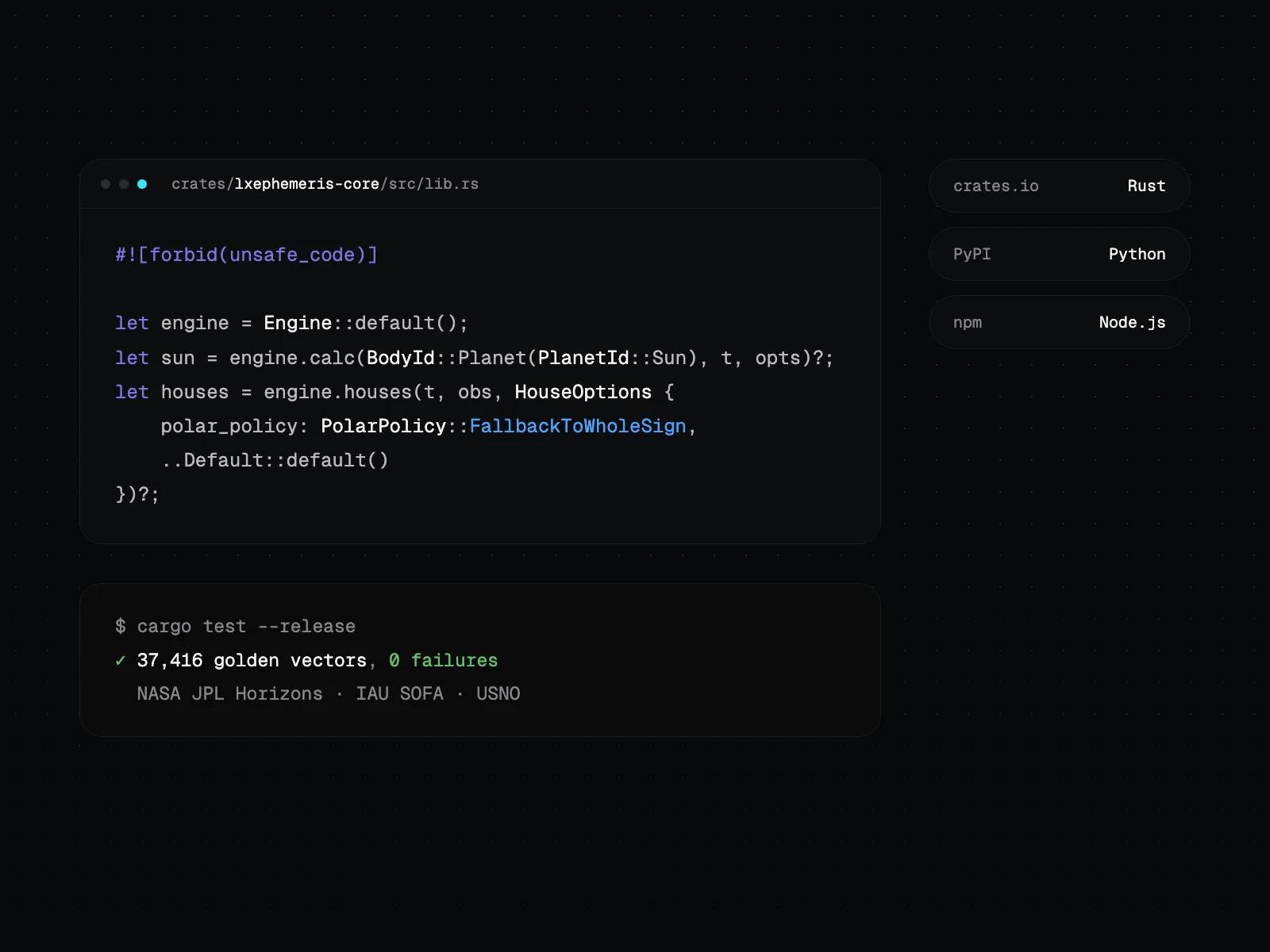
Case study: lxephemeris, one Rust engine in place of a C and Python stack
Astrology backends usually stitch together C bindings and Python wrappers that share global state and break under concurrent requests.
We wrote lxephemeris, a clean-room engine, to replace that stack for AstroAPI, and published it as open source.lxephemeris on GitHub
- ~150 µs
- Full natal chart
- 12.8 µs
- Per body with speed
- 0
- Lines of unsafe code in the core
When our Rust app development agency fits, and when it doesn't
We turn down work we cannot ship well. If your situation is in the second list, we will tell you and point to a better option.
This service is for you if
- ✓A Python or PHP service is your top cloud cost or latency problem
- ✓You need one library shared by Python, Node.js and Rust code
- ✓Crashes, races or memory bugs keep reaching production
- ✓You want the old system running while one part moves
- ✓You already run Rust and need senior review or more hands
Look elsewhere if
- ×Your bottleneck is the database or a slow third-party API
- ×You want a working app rewritten in one go try Discovery + MVP
- ×You need one engineer inside your team for a few months try team augmentation
- ×Your product is firmware or a game engine: we have no Rust case studies to show there
Most of the request is your own code
Rust fits
Most of the request waits on the database
Fix the query first
Ways to work with our Rust application development agency

Migration project
A 2-week discovery sets the scope, the target numbers and a fixed price for the first module.

Dedicated Rust development team
A senior team with a tech lead that owns a service end to end, with a demo every week. From $5k per month.

Staff augmentation: hire Rust developers
One or two senior engineers inside your team: a shortlist in 72 hours, you interview each one, at work in about 14 days.

What our clients say about our Rust software
Verified Clutch reviews of our engineering teams. For Rust proof, see the lxephemeris case above.
"The combination of speed, quality, and clear communication is rare, but ProCoders nailed all three."
"The level of service and support is outstanding."
 CTO, Manufacturer & Distribution Software Provider
What buyers ask before signing a Rust development contract
Not here? Write the question in the form. We answer in one working day.
01How much do Rust development services cost?
Price depends on scope and comes in writing before work starts. Rates start from $32 per hour across stacks, and a Rust rate depends on seniority. A dedicated team starts from $5k per month, a Sprint project from $12k. Senior engineers cost 45-65% less than a US in-house hire. Migrations get a fixed price after a 2-week discovery.
02Who owns the code, and do you sign an NDA?
You own it, and we sign an NDA before we see your code. The contract includes 100% code and IP transfer, the work runs under ISO 27001 processes audited every year, delivered code carries a 3-month warranty, and we hold USD 1M cyber and professional liability cover.
03Does Rust's compile time slow down delivery?
Builds take longer than in Python or PHP, and the time comes back in fewer production bugs. The compiler checks types, memory safety and data races at compile time, so many bugs fail the build instead of reaching users. Parity tests run against the old code, and a senior engineer reviews every pull request.
04Which Rust frameworks do you use for web development?
Axum or Actix for HTTP services, on the Tokio async runtime. Python bindings use PyO3 and maturin, Node.js packages use napi-rs, and a native PHP extension uses ext-php-rs, which ties you to PHP versions, so we pick it only when a network hop is too slow.
05How do you handle unsafe code and security in a Rust codebase?
We keep unsafe code out of the core and review every unsafe block that remains. Our own engine, lxephemeris, forbids unsafe code in its core at compile time. A code review covers unsafe blocks, error handling, async pitfalls and dependency audits, and ends with a fix plan.
More questions (3)
06Do you offer long-term support and maintenance after launch?
Yes. Delivered code carries a 3-month warranty, and after it a dedicated team or one or two engineers can keep running the service with a demo every week. If your team takes it over, you get the code, CI, benchmarks and docs. You can scale the team down or end it with 7 days notice.
07How do we track progress and communicate with your engineers?
Through a demo every week and the tools you already use. Our engineers join your Slack, your Jira, your repository and your standup, and they keep 5+ hours of overlap with US and EU working days.
08Do you offer Rust programming language training for our developers?
We do not sell a training course. Your developers learn on the job: they build alongside our engineers, every change goes through code review by a senior engineer, and the handover includes the code, CI, benchmarks and docs, so your team can run the service after we step back.
Guides for teams planning a Rust hire or a move off an old stack.
Discover more services from our software development company
Rust is one part of what our engineers build, next to backend work, integrations and AI development.
Tell us what you need.
Our Rust development company will quote the right way to work
Send the module that costs you most in latency or cloud spend. A 30-minute call, then a written scope, price and timeline for the Rust development services you need.