Healthcare Asset Management Software Development Services
We build software that tracks hospital equipment in real time, plans its maintenance and shows how often it is used.

Our Healthcare Asset Management Software Development Services
From consulting to support, our custom healthcare asset management software development gives clinical engineering and supply chain teams one place to see where each device is and when it needs service.
Healthcare Asset Management Software Consulting
We start with your asset register, workflows and the systems that already hold equipment data. In a 2-week discovery we map what to track, which tracking method fits each area and what the first release must prove, with a fixed price for it.
Custom Healthcare Asset Management Software Development
We build the platform around your asset classes, departments and approval rules instead of bending a generic product to them. You own the source code and IP, and delivered code carries a 3-month warranty.
Healthcare Asset Tracking Software Development
Location and status for pumps, ventilators, wheelchairs, beds and monitors, shown on the floor plans your staff already know. As a healthcare asset tracking software development company, we connect tags, readers and gateways to one live map and one search.
RFID, RTLS, and IoT Integration
We integrate passive and active RFID, BLE trackers and the RTLS platform you choose, plus IoT sensors that report temperature, power state or usage hours. Raw reads are filtered and deduplicated before they change an asset record.
Healthcare Asset Management System Integration
Equipment data moves between the new platform and your EHR, ERP, CMMS and procurement tools through their APIs or HL7 and FHIR interfaces. One record per device, kept in sync, instead of four exports.
Healthcare Asset Management Software Modernization and Support
Older on-premise or spreadsheet-based systems move to a maintainable stack feature for feature, with the full asset history migrated. After launch the same team monitors, patches and extends the platform.
Healthcare Asset Management Software Solutions We Build
Each product answers one question your teams ask every day. Most clients start with one and add the next once the first one is in use.
Real-Time Medical Equipment Tracking Systems
Real-time location of mobile medical equipment by floor, unit and room, with status such as in use, available, needs cleaning or out for repair. Staff search by device type and get the nearest available unit.
Medical Equipment Inventory Management Software
Inventory management for every medical asset: counts by department, par levels, loans between units and alerts when a unit drops below its minimum. A cycle count takes a scan instead of a clipboard.
Medical Equipment Maintenance Management Systems
Preventive maintenance by manufacturer interval or usage hours, work orders for biomedical engineers, and recalls tied to the exact serial numbers affected, with a full service history for each device.
Healthcare Asset Lifecycle Management Platforms
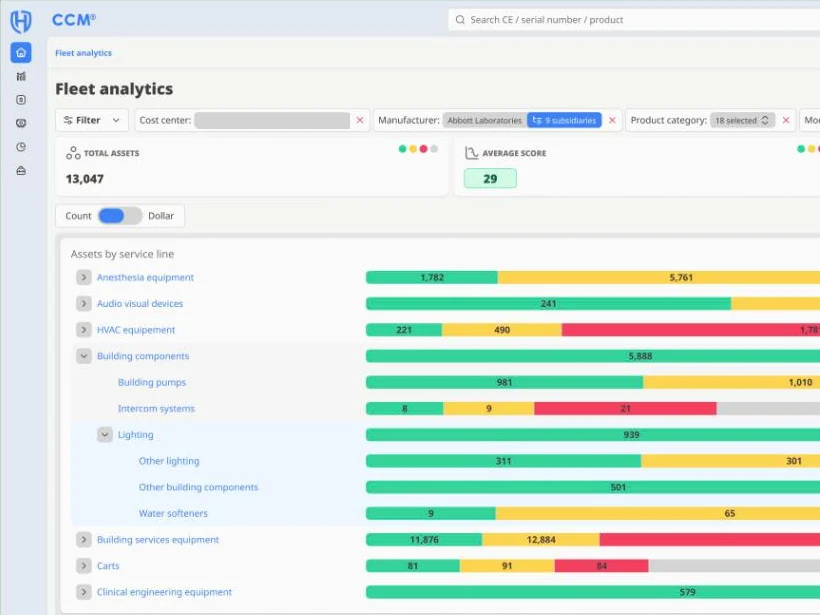
The asset lifecycle from purchase request to resale or disposal: depreciation, remaining life, condition scores and a replacement plan by service line. The capital cycle management system we helped HANDLE build works this way.
Hospital Asset Utilization and Analytics Solutions
Hospital asset utilization by device class and department: hours in use, idle time and where equipment sits unused. Reports show which units hold spare devices and which keep running short.

When Healthcare Organizations Need Custom Asset Management Software
Off-the-shelf tools work until your workflows, sites or systems stop matching their model. These are the usual signs that custom healthcare asset tracking software development is worth a look.
Difficulties Locating Medical Equipment
Nurses call around or walk the floors to find a pump or a portable monitor, and units keep hidden stock just in case. Every minute spent searching is a minute away from patients.
Fragmented Asset Records
The same device lives in a spreadsheet, the CMMS, the ERP and a vendor portal, each with a different status. Nobody trusts the count, so every audit and capital plan starts from scratch.
Unplanned Equipment Downtime
Missed inspections and late repairs take devices out of service when they are needed most. Without alerts, a failed check is found when a clinician picks the device up.
Poor Equipment Utilization
Some devices sit idle in storerooms while other departments rent or buy more of the same model. Without usage data, purchasing follows complaints instead of evidence.
Limited Integration with Existing Hospital Systems
A tracking tool that does not talk to the EHR, ERP or CMMS adds one more screen and one more manual export. Custom software fits into the systems you already run.
Key Features of Healthcare Asset Management Software
One record per device that every team reads from: where it is, what state it is in, its history and who changed it.
Real-Time Asset Location and Status
A live floor plan with every tagged device, filters by type and status, and a search for the nearest available unit. Location updates come from RFID reads, BLE gateways or RTLS events.
Asset Inventory and History Tracking
Each device keeps its serial number, model, cost center, location history, service records and documents in one place, from receiving to disposal.
Preventive Maintenance Scheduling and Alerts
Maintenance plans by calendar or by usage, work orders assigned to technicians, and alerts for overdue inspections, recalls and devices leaving their permitted zone.
Asset Utilization Analytics and Reporting
Dashboards for use, downtime, maintenance cost and remaining life by device class, department and site, with exports for finance and audits.
RFID, Barcode, and QR Code Tracking
Barcode and QR labels cover low-cost items and manual checks; RFID covers bulk counts and doorway reads. Each device class gets the cheapest method that keeps its record accurate.
Role-Based Access Control and Audit Trails
Clinical staff, technicians, managers and vendors see only what their role allows. Every change to a device record is logged with who, what and when.
Mobile Access for Healthcare Staff
Mobile apps to scan, find, check out or report a faulty device on the ward, built in React Native or as a web app, with an offline mode for basements and dead zones.
Healthcare Asset Tracking Technologies and Integrations
Our healthcare asset tracking software development services pick the tracking method per device class and area, then connect it to the systems that already run your hospital.
RFID, BLE, and RTLS Technologies
Passive RFID suits bulk counts and doorway reads at a low tag cost. BLE trackers with gateways give room-level location. Where you need bed or bay accuracy, RTLS platforms add infrared or ultrasound, and we integrate the vendor you pick.
IoT Devices and Sensor Data Integration
Sensors report temperature, power draw, usage hours and battery levels. We ingest those streams, filter the noise and turn them into status changes and alerts.
EHR, ERP, and CMMS Integration
EHR integration over HL7 or FHIR links devices to patient encounters where you need it. ERP integration keeps purchase and depreciation data in sync, and CMMS integration shares work orders and service history.
Cloud-Based Asset Management Infrastructure
We deploy on AWS, Azure or Google Cloud, or in your private cloud, with encryption, backups and monitoring. The platform grows from one hospital to a network of sites without a rebuild.
Benefits of Custom Healthcare Asset Management Software
The gains come from fewer searches, fewer surprises and fewer devices bought to cover for the ones nobody can find.
Reduced Equipment Search Time and Improved Visibility
When staff can see where a device is, they stop walking the floors to look for it. Clinical time goes back to patients, and operational efficiency goes up.
Improved Equipment Utilization
Usage data shows idle stock, so devices move to the units that need them before anyone rents or buys more.
Reduced Equipment Downtime
Maintenance alerts and usage-based schedules catch service needs before a device fails, so fewer units are out of service when a ward needs them.
Optimized Maintenance and Asset Lifespan
Service history, condition scores and remaining life show which devices to repair, which to keep and which to replace, so each one runs its full useful life.
Data-Driven Equipment Purchasing Decisions
Capital requests come with use, downtime and replacement cost figures instead of guesses. At HANDLE, capital planning tools like these were part of the new services that raised the company's income by 30%.
Our Healthcare Asset Management Software Development Process
Five steps with one owner, one timeline and a demo every week once the build starts.
Discovery and Requirements Analysis
In two weeks we review your asset register, floor plans, workflows and systems, then agree on scope, tracking method, timeline and a fixed price for the first release.
Solution Architecture and Technology Selection
We design the data model, integration points and hosting, and choose tags and readers per area. You see the trade-offs before any code is written.
Custom Software Development and Integration
Senior engineers build in two-week sprints and work with AI tools; a person reviews every pull request. Integrations are tested against your EHR, ERP and CMMS sandboxes.
Testing and Deployment
We test with real tags on a pilot unit, check location accuracy and alert rules with your staff, then roll out site by site.
Maintenance and Continuous Improvement
After launch we monitor, patch and extend the platform. You get 100% of the source code and IP, with a 3-month warranty on delivered code.
Healthcare Asset Management Software Development Engagement Models

Dedicated Development Team
A team with a tech lead, QA and a project manager that owns the platform end to end and demos every week.

Team Augmentation
Senior developers join your in-house team in about 14 days, after a shortlist in 72 hours. Unlike a recruiting agency, we keep them on our staff and replace one without penalty.

End-to-End Software Development
We take the product from discovery to launch at a fixed price per release and hand over the code, docs and infrastructure.
Why Choose ProCoders as Your Healthcare Asset Management Software Development Company
What you get from a healthcare asset management software development company that has already built capital planning tools for hospital equipment.






Custom Software Built Around Healthcare Workflows
We build around how your nurses, biomedical engineers and supply chain staff work, not around a vendor's default screens, for hospital networks, equipment providers and medtech firms alike. HANDLE's capital cycle management system tracks warehouses, asset movement, depreciation and resale timing.
IoT Software Development Expertise
Our IoT software development work covers sensor data, device apps and dashboards, from Roth River's barrel sensors to Avanto Care's health trackers.
Enterprise System Integration Capabilities
We connect new platforms to ERPs, EHRs, CMMS tools and procurement systems through APIs and integration middleware, with tests that run on every release.
ISO 27001-Certified Security Practices
Our processes are ISO 27001 certified. Access control, encryption, audit logs and code review are part of every project, and HIPAA or GDPR controls are available on request.
Flexible Development Teams
Start with two developers and grow when the scope does, as HANDLE did: two engineers within days, then four and a QA automation engineer. Team size changes with 7 days notice.
Long-Term Software Support and Scalability
500+ companies have worked with us since 2015, and our engineers stay a median of five years, so the people who built your platform are the ones who support it.
Our Healthcare Software Development Case Studies
Equipment lifecycle software for a medical equipment marketplace, and an eHealth IoT product built with a Swedish startup.



What Our Partners Say
"We're impressed with their ability to understand our needs and match us with the right developer."
 CTO, Co-Founder & CPO, Avanto Care
"We maintain our partnership and team dynamics with no plans to end any time soon."
 Founder & CPO, Roth River
"Based on our experience, we would highly recommend others to consider using ProCoders."
Healthcare Asset Management Software Development Cost Factors
A dedicated team starts from $5,000 a month, and a first release gets a fixed price after a 2-week discovery. Six things move the number.
Software Features and Complexity
Tracking and inventory alone cost less than a platform that adds maintenance, depreciation, analytics and approval flows. We price the first release, not the whole roadmap.
Asset Tracking Technologies
Barcodes cost almost nothing, RFID needs readers, and RTLS needs gateways and site surveys. Hardware is bought from the vendor; we price the software that uses it.
Healthcare System Integrations
Each EHR, ERP or CMMS connection adds design, mapping and testing work. A system with a modern API costs less than one that needs HL7 interfaces or file exports.
Number of Facilities, Assets, and Users
More sites, devices and users mean more floor plans, roles, data volume and rollout effort. The core stays the same.
Security and Compliance Requirements
Audit trails, encryption, single sign-on and HIPAA or GDPR controls add work in design and testing. We scope them in discovery instead of retrofitting them.
Deployment, Maintenance, and Support
Cloud or on-premise hosting, uptime targets and the support hours you need set the running cost after launch.
Healthcare Asset Management Software Development FAQs
Not here? Write the question in the form. We answer in one working day.
01What is the difference between healthcare asset tracking and asset management software?
Tracking software tells you where a device is and what state it is in, using RFID, BLE or RTLS. Asset management software covers the whole lifecycle: inventory, maintenance, depreciation, utilization and replacement. Most hospitals need both on one asset record, and we build them as one platform or connect the two.
02Can you integrate asset tracking software with existing hospital systems?
Yes. We connect to EHR systems over HL7 or FHIR, and to ERP, CMMS and procurement tools through their APIs. Each integration is tested in your sandbox first, and data flows both ways, so nobody types the same serial number twice.
03How long does it take to develop healthcare asset management software?
A first release with tracking, inventory and maintenance for one site typically takes about 12 weeks after a 2-week discovery, depending on scope and integrations. More sites and modules follow in two-week sprints.
04Can you modernize existing healthcare asset management software?
Yes. We move legacy or spreadsheet-based systems to a maintainable stack feature for feature, migrate the full asset history and run the old and new systems side by side until your team signs off.
05How much does healthcare asset management software development cost?
It depends on features, tracking hardware, integrations, the number of sites and compliance needs. Our senior engineers cost 45-65% less than a US in-house team, a dedicated team starts from $5,000 a month, and a first release gets a fixed price after a 2-week discovery.
More on healthcare systems, equipment data and the IoT behind them.
Discover More Services We Provide
Other ways to work with our engineers:
Discuss your project
Tell us which equipment you track, how many sites you run and which systems it must talk to. Our healthcare asset management software development services start with a 30-minute scoping call.